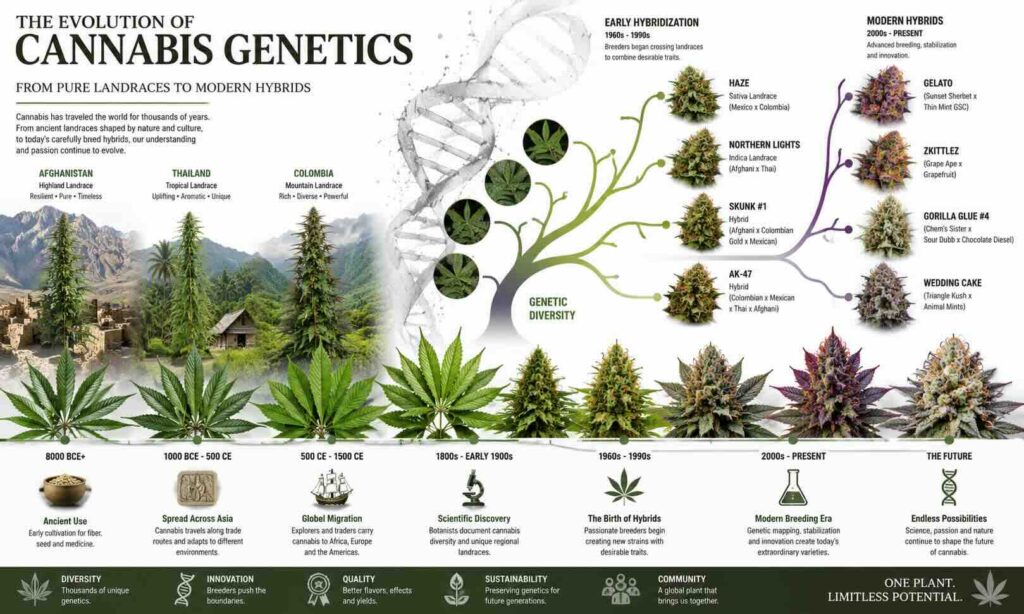
Cannabis genetics have undergone an extraordinary transformation over the centuries. As a breeder, I have always been fascinated by the journey from pure landrace populations, shaped entirely by nature and local environments, to the sophisticated hybrids cultivated today. Every modern cannabis variety carries a genetic story that reflects generations of adaptation, selection, and breeding innovation. Understanding this evolution helps growers appreciate the remarkable diversity that exists within the cannabis plant.
Modern cultivators often focus on characteristics such as vigor, structure, aroma, resin production, and cultivation performance. However, these traits did not appear overnight. They are the result of decades of breeding work built upon the foundation established by ancient landrace populations. The cannabis industry as we know it today would not exist without the preservation and development of these original genetic resources.
The Foundation of Cannabis Genetics
Before the emergence of modern seed banks and breeding programs, cannabis populations evolved naturally in different regions around the world. These populations became known as landraces. They adapted to local climates, daylight cycles, temperatures, humidity levels, and seasonal variations over countless generations.
As a breeder, I consider landraces the backbone of cannabis genetics. They represent unique combinations of traits that developed through natural selection rather than deliberate human intervention. Plants growing in mountainous regions often developed differently from those thriving in tropical environments, resulting in remarkable genetic diversity.
These regional populations provided the raw material that future breeders would use to create entirely new cultivars. Without landraces, modern breeding would have had no foundation upon which to build.
The Emergence of Selective Breeding
The next major step in cannabis evolution occurred when growers began selecting plants with desirable characteristics and using them to create future generations. This marked the beginning of selective breeding.
Rather than simply preserving naturally occurring populations, breeders started identifying specific traits they wished to enhance. Some focused on vigor and adaptability, while others selected for structure, flowering characteristics, consistency, or resin production. Over time, this process allowed breeders to create increasingly stable and reliable cultivars.
As a breeder, I have learned that successful selection requires patience. Valuable traits often reveal themselves only after careful observation throughout multiple generations. Consistency is rarely achieved quickly, which is why long-term breeding projects remain essential to genetic development.
How Hybridization Changed Cannabis
The introduction of hybrid breeding transformed the cannabis world. By crossing plants from different genetic backgrounds, breeders gained the ability to combine characteristics that previously existed in separate populations.
This dramatically expanded the possibilities available to cultivators. Hybrid plants could inherit vigor from one lineage, structural characteristics from another, and adaptability from a third. The resulting combinations created entirely new opportunities for cultivation and genetic improvement.
Today, most commercially available cannabis varieties are hybrids. These cultivars represent decades of breeding work designed to combine desirable traits into stable and productive genetic packages.
Growers interested in exploring modern cannabis genetics can learn more through Ministry of Cannabis, where breeding knowledge and cultivar development continue to play an important role in preserving and advancing cannabis genetics.
The Importance of Preserving Landrace Genetics
While innovation remains important, preserving original genetics is equally critical. Many breeders recognize that landraces contain valuable traits that may become increasingly important in future breeding projects.
Genetic diversity helps ensure that breeders have access to a broad range of characteristics when developing new cultivars. Preserving landraces also helps protect the historical foundation of cannabis breeding.
As a breeder, I believe preservation and innovation must work together. Progress is strongest when it respects the genetic heritage that made it possible.
The continued conservation of diverse genetic resources remains one of the industry’s most important responsibilities.
The Future of Cannabis Genetics
The future of cannabis breeding will likely combine traditional selection techniques with modern scientific tools. Advances in plant science, cultivation technology, and genetic analysis continue providing breeders with deeper insights into inheritance patterns and plant development.
These innovations create opportunities for greater precision while maintaining the importance of careful observation and long-term selection. At the same time, breeders must continue preserving genetic diversity to ensure future generations have access to valuable breeding material.
As a breeder, I am optimistic about the future of cannabis genetics. The combination of historical knowledge, scientific progress, and global collaboration creates exciting opportunities for continued development and discovery.
Final Thoughts
The evolution of cannabis genetics from pure landraces to modern hybrids represents one of the most fascinating stories in agricultural breeding. Through generations of adaptation, selection, preservation, and innovation, cannabis has become one of the most diverse cultivated plants in the world.
Readers interested in cannabis developments in France and Europe can explore additional industry information through https://www.newsweed.fr/categ/actualites-cannabis/europe/france/.
As a breeder, I see cannabis genetics as a living archive of both natural evolution and human ingenuity. Protecting that diversity while continuing to innovate will remain essential to the future of cannabis cultivation.